

- Technologies
- Solace
- Event Driven Architecture
Solace Event Driven Architecture
Design systems that respond to change as it happens
We help organisations implement event-driven architecture using Solace, enabling systems to react, coordinate and operate in step

How systems behave today
Modern architectures are well connected.
Most organisations have invested in APIs, cloud platforms and modern data stacks. These provide strong foundations for connectivity and scalability.
In practice, behaviour across systems often remains uneven.
When something changes in one part of the business:
Some systems respond immediately
Others react later or require polling
Some never receive the update at all
This leads to delays between actions, inconsistent views of what is happening and increasing reliance on manual intervention. Over time, this limits how effectively the organisation can operate in real time.








What event-driven architecture enables
Event-driven architecture allows systems to respond to change as it occurs.
When an event happens:
It is published once
It becomes available to all relevant systems
Those systems act on it immediately
This creates a model where information flows continuously, systems remain aligned and behaviour becomes consistent across the estate.




How this works in practice
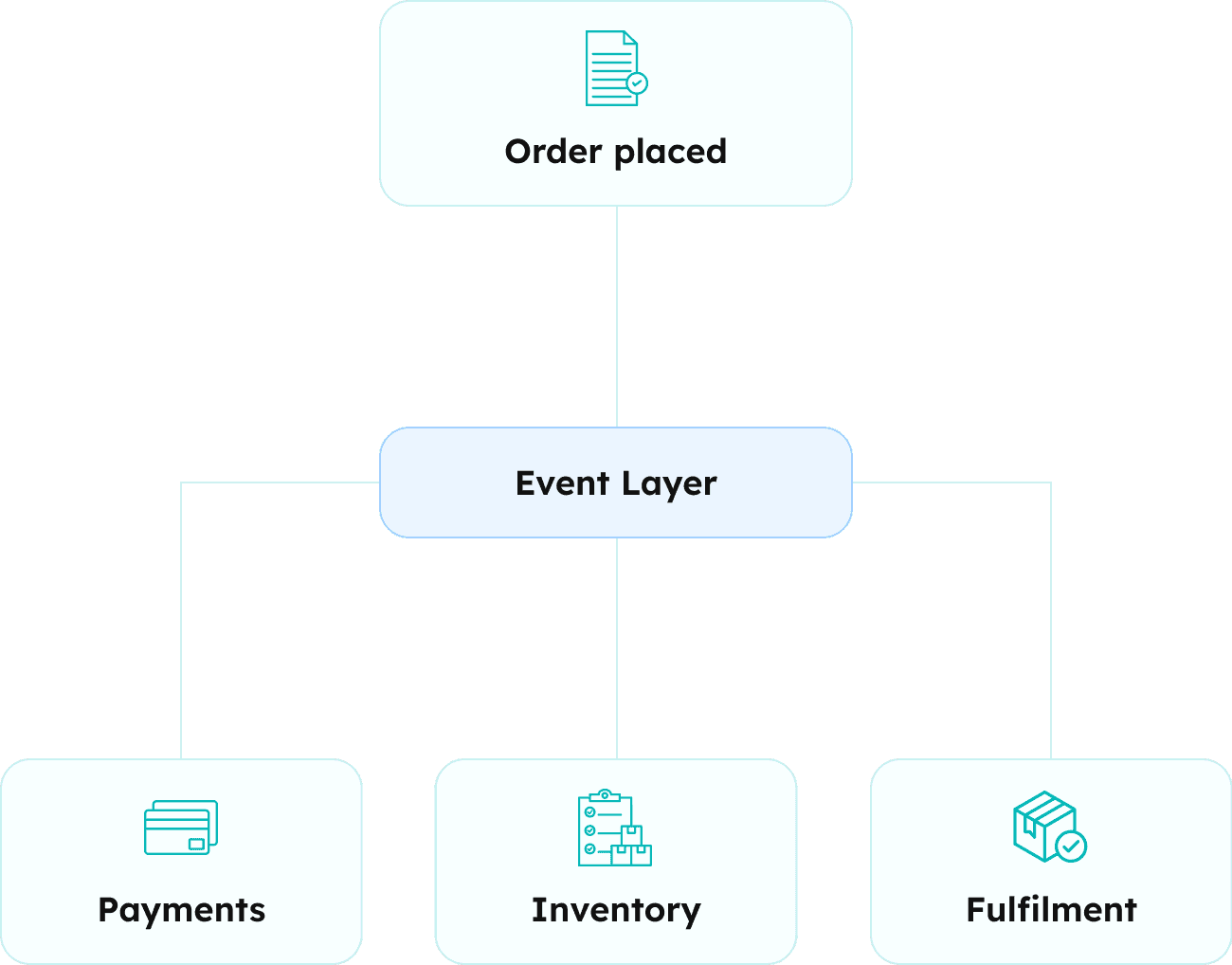
Consider a simple example. A customer places an order.
The payment system emits an Order Paid event
The inventory system updates stock levels
The fulfilment system prepares shipment
The customer system updates order status
Each system reacts independently, but to the same event.
There is no need for direct coordination between systems. Behaviour remains consistent because all systems are responding to the same source of truth.
How it works
Event-driven architecture introduces a shared layer where events are distributed across systems.
Talk to an expertApplications and services
Publish events when something changes
Subscribe to events that are relevant to them
This reduces dependency between systems and removes the need for tightly coupled integrations.
As the architecture evolves
New systems can be added without redesigning existing integrations
Behaviour remains stable
Changes can be introduced with less risk

Where it fits
Event-driven architecture complements existing architectural components.
It works alongside:
API layers for structured access
Integration platforms for orchestration
Cloud services for execution
Data platforms for storage and analytics
Together, these enable systems to operate with continuous awareness of change across the organisation.







Where it is applied
Event-driven architecture is particularly valuable in environments where multiple systems must respond to change quickly and consistently.
It supports organisations that rely on accurate, real-time information to coordinate operations across teams, platforms and services.
Healthcare (NHS)
Patient events trigger coordinated clinical and operational responses
Government
Changes in one department are reflected consistently across others
Transport & logistics
Operational updates propagate instantly across systems
Retail & supply chain
Inventory, pricing and fulfilment remain aligned in real time
The role of Solace
Solace provides the infrastructure required to implement event-driven architecture at scale.
It enables:
Reliable distribution of events
Dynamic routing across environments
Consistent delivery across systems
This supports event-driven models in complex, distributed environments.



The Claria approach
As a Solace partner, we design real-time data streaming around how organisations use and depend on their data.
That includes:
Identifying key business events
Defining how those events flow across systems
Ensuring consistent responses across the estate
Integrating event-driven architecture into the broader platform strategy
We use Solace to enable continuous, low-latency data flow across distributed environments, ensuring information is available where and when it is needed.
This creates an architecture that supports real-time operations and remains manageable as it grows.
Our Clients








Ready to improve how your systems respond to change?
Send us a message and we’ll get right back to you.
Call us on
Email us on